

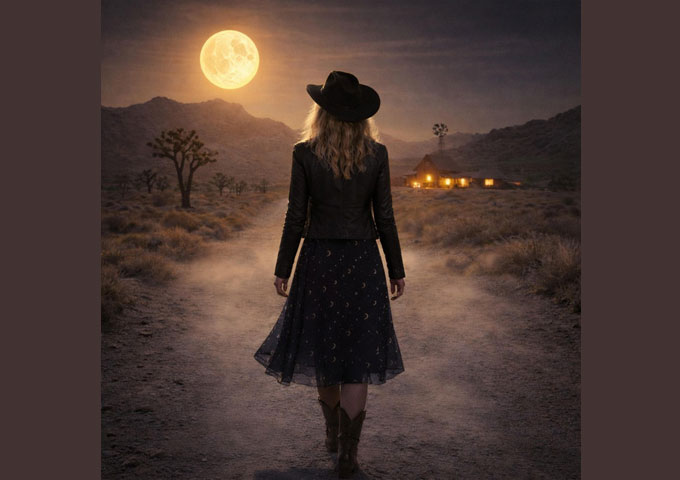
A slow-burning invitation into a world of nocturnal reflection. Where intimate vocals meet lush, atmospheric production. A quietly powerful song that reveals its magic with every listen
Natascha Spring’s “Velvet Moon” is a song that understands the emotional power of restraint. Rather than rushing toward a dramatic chorus or attempting to seize attention through sheer immediacy, the track takes a more patient route, allowing its atmosphere to accumulate gradually until the listener is fully immersed. It is dream-pop in the most evocative sense of the term, music that seems to exist somewhere between waking reality and memory, where images become impressions and emotions linger longer than words.
From its opening moments, “Velvet Moon” establishes an intimate sense of space. The arrangement feels deliberately unhurried, giving each musical element room to breathe while creating the impression of an emotional landscape slowly coming into focus. The effect is cinematic without becoming overly grandiose. Rather than telling the listener exactly what to feel, Natascha Spring creates the conditions in which feeling can happen naturally.
That distinction is important. Much atmospheric music relies on texture as an end in itself, but “Velvet Moon” uses atmosphere as a vehicle for emotional storytelling. The gradual development becomes part of the narrative. The track begins in a state of delicacy and vulnerability before progressively opening outward, introducing greater richness and intensity without sacrificing the sense of calm that defines its identity.
At the center of this unfolding is Natascha Spring’s vocal presence. Her delivery is understated, expressive and carefully controlled, resisting the temptation to overstate the emotional material. That restraint gives the performance considerable strength. The voice feels less like an actor performing an emotion and more like an individual quietly inhabiting it. Every phrase becomes part of the atmosphere, contributing to the sensation that the listener has entered a private moment of reflection.
The title “Velvet Moon” itself provides a particularly evocative key to understanding the song. Velvet suggests softness, intimacy and tactile warmth, while the moon carries associations with solitude, dreams, memory, distance and nocturnal contemplation. Together, the two images suggest an emotional world that is gentle but not weightless, beautiful but touched by melancholy. The moon does not simply illuminate the darkness. It becomes a symbol of emotional distance and quiet observation, while velvet implies the comforting softness with which those feelings are experienced.
That duality appears to be central to the song’s emotional appeal. “Velvet Moon” does not present reflection as something exclusively sad, nor does it reduce nostalgia to sentimental escapism. Instead, it seems to occupy the space between remembering what has been and remaining open to what might still come. Its emotional language suggests that melancholy and hope do not have to contradict each other. They can coexist, sometimes within the same moment.
The lyrical conception is therefore especially effective when considered alongside the music’s gradual progression. Rather than treating the words as a conventional narrative that must arrive at a definitive conclusion, the song appears to use lyrical imagery as a series of emotional impressions. Memory, longing and hope become interconnected rather than isolated themes. The listener is encouraged to contemplate rather than simply follow a storyline.
This gives “Velvet Moon” a quality that is increasingly rare in contemporary listening culture. It rewards attention instead of demanding it. The song does not appear designed around the idea that everything important must happen immediately. Its emotional payoff depends on accumulation, with the atmosphere becoming progressively more substantial as the track advances.
That approach also makes the song particularly suited to repeat listening. A first encounter introduces the landscape. Subsequent listens allow the listener to notice the subtleties within it. The quieter moments become more meaningful because the listener already understands where the music is capable of going. The eventual expansion consequently feels earned rather than artificially engineered.
The production philosophy behind Natascha Spring adds another fascinating dimension to the track. The creator behind the project, däh De, draws from the sound and spirit of dance music developed between the mid-1970s and mid-1980s, a period whose influence can still be heard throughout contemporary pop, electronic music and disco-inspired production. Yet däh De is not confined to a strict retro recreation. Its musical vocabulary stretches from groove-oriented disco and funk toward melodic, song-driven pop, drawing upon the era’s fascination with strong melodies, rhythmic clarity and movement.
That background gives “Velvet Moon” an intriguing conceptual foundation. Although the track’s immediate identity is dream-pop and cinematic rather than overtly dancefloor-focused, its sense of pacing and musical architecture can be understood through the project’s broader appreciation for rhythm and melody. The retro influence is not presented as nostalgia for nostalgia’s sake. Instead, it is reinterpreted through a modern production sensibility.
This is where däh De’s approach becomes particularly compelling. The project appears interested in preserving the emotional directness and melodic confidence associated with classic songwriting while allowing contemporary production techniques to reshape the surrounding environment. “Velvet Moon” consequently feels neither like a museum piece nor like a retro exercise. It occupies a contemporary space while carrying the warmth and musical intentionality of an earlier pop tradition.
The song’s greatest achievement, however, may be its understanding of emotional pacing. Its progression from fragility to immersion mirrors the way genuine memories often work. A single image, sound or sensation can initially seem insignificant before suddenly opening a much larger emotional chamber. “Velvet Moon” operates according to a similar principle. It starts quietly, but its quietness is not emptiness. It is anticipation.
As the arrangement expands, the listener becomes increasingly aware of the emotional stakes beneath the surface. The music does not need to become dramatically louder or excessively theatrical to communicate that transformation. Instead, its increasing density and movement create the feeling of emotional doors gradually opening.
By the time the track reaches its fullest expression, the journey feels natural. Nothing has been forced. The music has simply followed its own internal logic, moving from intimacy toward expansiveness and from contemplation toward release.
That sense of release is also why “Velvet Moon” leaves such an appealing afterglow. The song does not conclude by exhausting its emotional possibilities. If anything, its ending encourages the listener to return to the beginning and experience the journey again. The desire to replay it comes not from an aggressively engineered hook, but from the recognition that its atmosphere contains details and feelings worth revisiting.
Natascha Spring therefore emerges from “Velvet Moon” as an artist project defined by poise rather than excess. The performance trusts silence, space, melody and gradual development. Behind it, däh De provides a production philosophy grounded in the enduring principles of melody, groove and positive musical energy, while allowing those principles to inhabit a much more reflective contemporary setting.
Ultimately, “Velvet Moon” is a song about allowing an emotional moment to breathe. It understands that intimacy can be more powerful than spectacle and that a song does not necessarily need to reveal its entire identity within its opening seconds. Sometimes the most rewarding musical experiences are the ones that ask the listener to remain present.
With its dreamlike atmosphere, understated vocal character, cinematic progression and delicate balance between nostalgia and hope, Natascha Spring’s “Velvet Moon” offers precisely that kind of experience. It is music for late-night thoughts, distant memories, quiet rooms and moments when the outside world seems to soften around you.
Most importantly, it is a song that trusts the listener.
Give it time, and “Velvet Moon” gradually becomes something more than an atmospheric dream-pop track. It becomes a place to return to, a fleeting emotional world illuminated by its own particular light, where softness carries weight and reflection can ultimately lead toward hope. Once that world fades into silence, the instinct to press play again feels less like repetition and more like returning home.
OFFICIAL LINKS: FACEBOOK – SPOTIFY – INSTAGRAM – YOUTUBE – TIKTOK


