

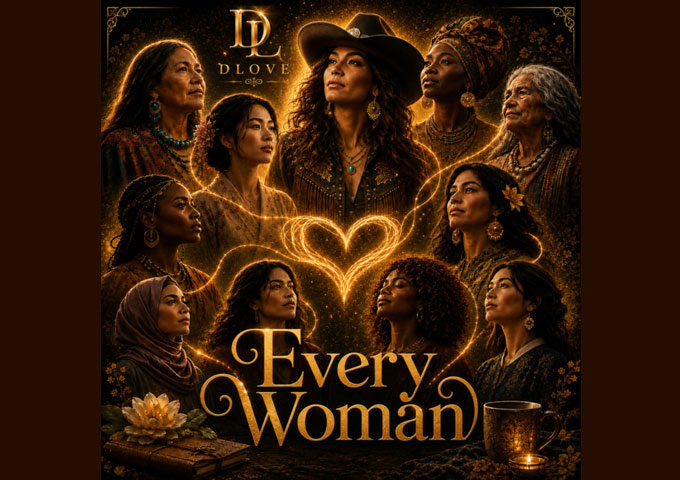
DLove transforms personal struggle into a universal emotional language. “Every Woman” listens closely to the stories hidden beneath familiar smiles. Country-pop warmth meets a vocal performance shaped by vulnerability and resolve. The song honors mothers, daughters, dreamers, survivors, believers, and women rebuilding themselves. Most importantly, DLove turns individual pain into a collective declaration that no one walks alone.
DLove arrives with “Every Woman” not simply as a singer delivering another inspirational song, but as a deliberately constructed artistic voice capable of carrying countless stories at once. The track occupies a compelling space between contemporary country-pop storytelling, spiritual reflection, and emotionally direct adult contemporary songwriting, using familiar human experiences as the foundation for something considerably larger than a conventional love song. Its subject is love, but not love confined to romance. This is love as endurance, faith, self-recognition, forgiveness, motherhood, friendship, survival, and the stubborn decision to keep moving forward when circumstances have offered very little reason to do so.
That distinction matters because DLove is not designed around the biography of one particular woman. She is an artistic vocal persona and creative collaborator created to represent a wider emotional landscape, giving listeners room to recognize themselves rather than asking them to study the life story of a single performer. The concept was created and directed by Darren Williams, using AI-assisted tools within a human-led songwriting, production, and visual process. The technology is therefore part of the creative framework, but the emotional purpose of the music remains unmistakably human. DLove functions as a vessel for stories about love, faith, loss, resilience, healing, relationships, and hope, with “Every Woman” making that philosophy especially explicit.
The opening imagery immediately establishes the song’s central idea through metaphor rather than exposition. The woman at the heart of the lyric is presented as someone who has learned to construct tomorrow from the remnants of yesterday. The image of stitching suggests patience, repair, and craftsmanship, implying that survival is not passive. She actively rebuilds. Her broken dreams are not erased or romanticized. They remain close by, reminders of what happened and what might have been. That is one of the song’s strongest lyrical choices because it refuses to pretend that resilience requires forgetting.
The following verses deepen that portrait by exploring the private dimensions of suffering. Silence becomes something complicated, almost multilingual, because pain does not always announce itself in obvious ways. The woman described by DLove can smile while carrying scars, continue walking while emotionally exhausted, and conceal tears that nobody else notices. Yet the song introduces a spiritual dimension by suggesting that heaven knows what other people cannot see. This turns private suffering into something witnessed, giving the lyric a quiet theological reassurance without making the song dependent on a single religious interpretation.
That spiritual thread becomes increasingly important as “Every Woman” expands its perspective. The lyric moves from one woman’s experience toward many different versions of womanhood. Some build, some protect themselves, some raise children alone, and some leave familiar surroundings in search of something better. The imagery of crossing oceans while carrying hope after hope has seemingly disappeared captures the paradox at the heart of the song: hope is most meaningful precisely when circumstances have made hope difficult.
The song’s most affecting conceptual shift arrives when individual stories become a collective chorus of identities. Daughters, mothers, dreamers, survivors, and women who continue choosing love are not treated as separate categories. Instead, they become different expressions of the same fundamental human desire to be seen, valued, and allowed to continue becoming. The recurring heartbeat imagery reinforces that connection. Different lives can contain radically different circumstances while still sharing the same emotional pulse.
This is where the title “Every Woman” takes on its full significance. The phrase does not point toward one representative figure. It deliberately refuses the idea that there must be a single face standing in for everyone else. The lyric’s declaration that the voice belongs to every woman transforms DLove from an individual character into a collective narrator. That choice gives the song unusual flexibility. A listener can hear a mother speaking. Another can hear a daughter. Someone else may recognize the voice of a woman who survived loss, left a relationship, rebuilt her confidence, rediscovered faith, or simply learned to appreciate her own existence again.
Musically, that concept benefits from the accessibility of contemporary country-pop. The style naturally accommodates narrative songwriting because it can leave space for the words while surrounding them with melodic warmth. “Every Woman” does not need excessive lyrical complexity to communicate its message. Its strength comes from emotional clarity, repetition, recognizable imagery, and a vocal approach that treats the material as testimony rather than ornament. The performance needs to sound as though the singer understands that every line carries somebody else’s memory, and that responsibility gives the song its emotional gravity.
The lyric’s treatment of pain is particularly effective because it consistently pairs hardship with transformation. Broken dreams can coexist with new beginnings. Tears can lead toward laughter. Pain can become a place from which beauty grows. Even the song’s language of grace suggests that healing is not necessarily about returning to an untouched version of oneself. Instead, the scars remain part of the story. The woman becomes stronger not because she was spared suffering, but because she learned how to carry what happened without allowing it to define the limits of her future.
The song also understands the importance of refusing celebrity as the measure of significance. The speaker does not need the world to know her name. That idea gives “Every Woman” one of its most powerful emotional foundations. Recognition does not have to arrive through fame, applause, or public achievement. A life can matter profoundly through acts that remain unseen. Raising a child, surviving heartbreak, extending forgiveness, keeping faith, starting again, or simply getting out of bed after an unbearable night can constitute its own form of courage.
The international dimension of the lyric broadens that message further. Different languages, faces, journeys, and faiths may create visible distinctions, but the song argues for a shared emotional core. This is not presented as an erasure of difference. Instead, difference becomes part of the song’s beauty. The point is not that every woman has lived the same life, but that radically different lives can still contain recognizable experiences of love, grief, hope, fear, courage, and renewal.
The line about one woman rising and the world remembering what courage sounds like provides the track with its clearest communal statement. Courage becomes contagious rather than competitive. One person’s recovery can give another person permission to imagine her own. One woman’s voice can become another woman’s language. That idea ultimately brings the song back to its central creative premise: DLove is not asking listeners to admire a fictional heroine from a distance. She is inviting them to hear themselves inside the music.
The closing image of a song still being written completes that philosophy beautifully. Nothing is presented as finished. The collective story remains in progress, and its melody is created through participation. The repeated suggestion that “we” become the melody shifts the listener from observer to participant. “Every Woman” therefore concludes not with a neat resolution, but with an open invitation to continue the story.
That may be the most compelling quality of DLove as an artistic concept. The persona does not depend on one biography because the music is designed to make room for many biographies. Through Darren Williams’ human-led creative direction and AI-assisted production process, DLove becomes a framework for exploring experiences that cross generations and cultures without pretending that every woman’s journey is identical.
“Every Woman” ultimately succeeds because its ambition is emotional rather than merely stylistic. It wants to make hidden experiences visible. It wants to honor the women whose victories were never publicly celebrated. It wants to recognize that vulnerability and strength are not opposites, but frequently exist in the same heartbeat. Most of all, it understands that love becomes more powerful when it refuses to belong to only one person.
With “Every Woman,” DLove offers a song about survival without reducing survival to a slogan, a song about faith without limiting faith to one interpretation, and a song about women without pretending that one story can represent them all. Its deepest message is beautifully simple: every woman carries a story, every story deserves to be heard, and sometimes the most meaningful music begins when one voice gives millions of others permission to hear their own.
OFFICIAL LINKS: SPOTIFY


