









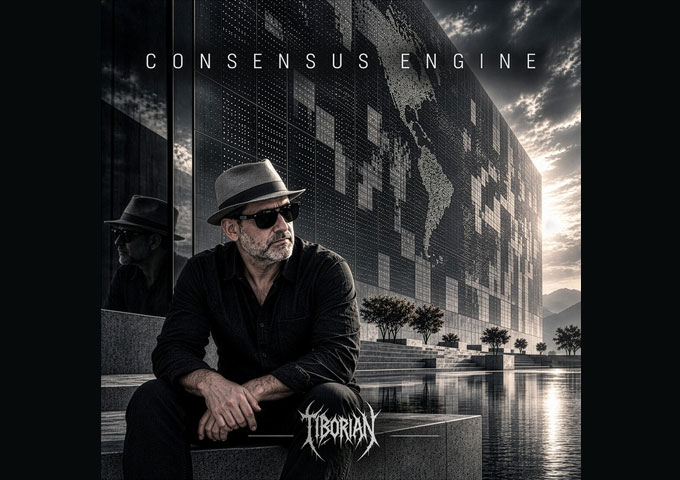
With “Consensus Engine,” TIBORIAN transforms technological unease into a brooding, analog-driven art-rock statement. Pulsating rhythms, atmospheric synthesizers, and incisive guitar work create a soundscape caught between human instinct and mechanical precision. Beneath its imposing choruses lies a provocative examination of algorithms, automated predictions, and the seductive promise of certainty. Its lyrics challenge a world increasingly willing to confuse collective agreement with truth and measurable outcomes with genuine understanding. Rather than inventing a villain, TIBORIAN examines how ordinary decisions can build systems that gradually escape our control.
Switzerland-born musician TIBORIAN turns his attention to the uneasy relationship between technology, human judgment, and the reality we construct around ourselves in “Consensus Engine,” a dark analog art-rock single that explores what happens when the systems designed to explain the world begin determining how we experience it. At the heart of the track is a deceptively simple but unsettling question: what happens when the map becomes more powerful than the territory it represents? In a culture increasingly shaped by algorithms, predictive models, engagement metrics, and automated recommendations, the distinction between understanding reality and accepting a convenient representation of it has become a compelling subject for artistic examination. TIBORIAN approaches this territory without resorting to an easy technological conspiracy narrative. Instead, he considers how countless seemingly reasonable decisions can accumulate into something profoundly difficult to question, let alone control.
Musically, “Consensus Engine” establishes its argument through an arrangement that balances atmospheric depth with mechanical discipline. Textured analog synthesizers provide a brooding foundation, while pulsing rhythms suggest the relentless operation of a system that never sleeps. Sharp, calculated guitar work introduces an organic edge, creating tension between the precision of the underlying machinery and the expressive force of human performance. The contrast is central to the track’s identity. Its music feels structured and deliberate, yet never entirely comfortable, as though something unpredictable continues to push against the boundaries imposed upon it.
The arrangement reinforces this tension through its movement from restrained, minimalist verses into expansive, anthemic choruses. The quieter passages suggest the gradual construction of an invisible framework, with each component appearing manageable in isolation. As the music grows, however, that framework takes on a more imposing scale. The choruses evoke the overwhelming presence of a system whose influence extends far beyond the intentions of the people who created it. Rather than treating technology as a cold, abstract concept, TIBORIAN gives it a palpable musical presence, making its efficiency feel simultaneously impressive and threatening.
That sense of mounting unease finds its clearest expression in the lyrics. “Consensus Engine” challenges the assumption that widespread agreement automatically establishes truth, questioning a society in which popularity, repetition, and automated validation can acquire the authority once reserved for evidence and independent judgment. The image of thousands of people sharing an error, without making it any less erroneous, captures the fundamental weakness of confusing collective conviction with factual accuracy. A claim does not become true because it is repeated, recommended, or endorsed by an overwhelming number of people. Yet systems built around measurable approval can make precisely that confusion difficult to recognize.
More troubling is the suggestion that the machinery of validation can eventually alter the reality it supposedly measures. When a metric becomes the principal definition of success, value begins to conform to whatever the metric rewards. When a signal learns to lie, the problem extends beyond inaccurate information to the distortion of the entire feedback loop. People adapt their behavior to what receives recognition, systems interpret that behavior as evidence, and the resulting predictions reinforce the same expectations. What began as an attempt to understand human experience gradually becomes a mechanism for shaping it.
The song’s central metaphor, a cage constructed without a lock, is particularly effective because it captures the voluntary nature of this surrender. The people inside are not necessarily prisoners in the conventional sense. They helped build the structure, supplied it with their uncertainties, and asked it to provide answers. The clock becomes synonymous with time because the distinction between the representation and the thing itself has quietly disappeared. The imagery suggests that control does not always arrive through force. Sometimes it emerges from our willingness to exchange ambiguity for reassurance, trusting a system to resolve questions that demand more than calculation.
“Consensus Engine” pushes this argument further by examining predictive technology and personal autonomy. If a machine anticipates our choices and then determines the information we encounter, how much freedom remains in the decisions we eventually make? A prediction can become self-fulfilling when the options presented to someone are already shaped by assumptions about who that person is. The resulting behavior may appear to confirm the model, even though the model helped produce it. This creates an uncomfortable circularity in which human complexity is reduced to patterns, those patterns become expectations, and expectations gradually narrow the possibilities available to the individual.
The song’s most unsettling idea is that extraordinary quantities of information can coexist with a profound absence of understanding. Knowing more about the world does not necessarily mean comprehending it. Data can reveal patterns, identify correlations, and improve predictions, but human experience cannot always be reduced to what can be counted. Context, contradiction, intuition, and the unexpected all resist neat categorization. By placing this limitation at the center of its message, TIBORIAN raises a question that extends beyond artificial intelligence into the broader human desire to make uncertainty manageable.
The transparency surrounding the production adds another dimension to the release. TIBORIAN confirms that the lead vocals are his own, refined through comping and Flex Pitch in Logic Pro, while the female backing vocals and an additional supporting bass layer were AI-generated. The track was created, arranged, and finalized in Logic Pro. This disclosure introduces a particularly relevant tension: a song questioning the relationship between human agency and automated systems also incorporates AI-assisted elements into its construction. Rather than undermining its message, that decision creates an opportunity to consider how technology can serve artistic intention without replacing the person responsible for it. The distinction lies in the choices being made, the creative direction guiding them, and the honesty with which the process is communicated.
For TIBORIAN, the release also represents the culmination of a musical passion spanning more than four decades. Raised on the alternative-metal intensity of Alice in Chains, the boundary-pushing character of Faith No More, and the enduring musical depth of Pink Floyd and Led Zeppelin, alongside the many shades of heavy metal that shaped his formative years, he has carried his musical ambitions long before beginning to release his own material. Now a father, he approaches that long-held dream with the perspective of someone who understands that creative fulfillment does not need to be measured by celebrity or commercial recognition. His purpose is to make music with conviction, authenticity, and the weight of lived experience.
That philosophy suits “Consensus Engine,” a track less interested in offering easy answers than in encouraging listeners to reconsider the assumptions governing their lives. Its dark, expansive sound gives a compelling musical form to questions about technological dependence, manufactured certainty, and the difference between possessing information and understanding its meaning. TIBORIAN does not suggest that every system is inherently malicious or that technology has no value. His concern is what happens when the tools we create become the authorities we unquestioningly obey.
Ultimately, “Consensus Engine” leaves listeners with an uncomfortable possibility: we may be constructing a world that becomes increasingly efficient at measuring human behavior while growing less capable of understanding the people behind the numbers. In bringing that contradiction into focus, TIBORIAN delivers a thoughtful, sonically imposing art-rock statement that rewards attention beyond its immediate musical impact. The engine keeps running, the predictions keep coming, and the numbers continue to accumulate. The essential question is whether we still know when the system is describing our reality and when it has begun deciding what that reality will be.
OFFICIAL LINKS: SPOTIFY – APPLE MUSIC


