

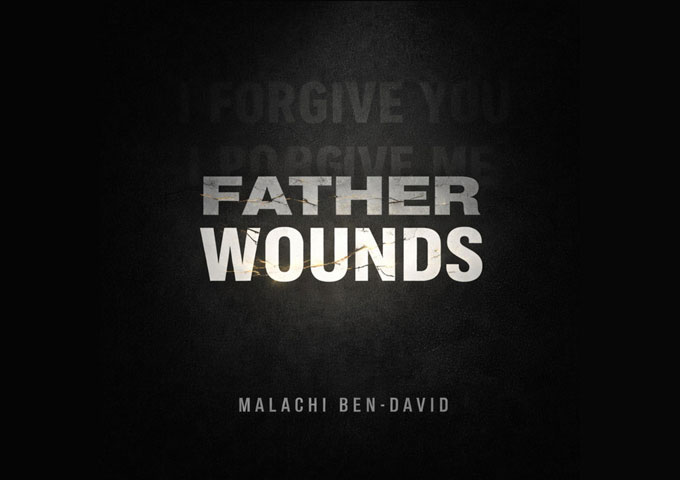
There are songs that entertain, songs that inspire, and then there are songs that reach into the chest and rearrange something. Malachi Ben-David’s new single “Father Wounds” belongs to that rare third category — a gritty, soul-baring collision of Gospel Blues and Contemporary Christian Hip Hop that refuses to sanitize its pain for the sake of palatability. This is Trench Worship in its most honest form, and it may be the most important track to come out of the CHH space this year.
From the opening bars, “Father Wounds” establishes itself as something categorically different from the polished Sunday anthems that crowd the Christian music landscape. Malachi Ben-David doesn’t arrive with well-rehearsed comfort. He arrives with a confession, one that sounds like it was murmured through broken cathedral walls, accompanied by church-like harmonies pressed up against street-level percussion that feels lived-in rather than engineered. The production carries weight without showboating, and that restraint is everything. It creates a sonic architecture that mirrors the emotional reality of the song itself: structured enough to hold together, raw enough to bleed.
The track opens with a dedication, not to a radio audience, but to the sons and daughters still limping through life with the invisible injuries that absent fathers leave behind. It’s a framing device that immediately communicates the song’s intent. This is not a record about other people’s pain; it is a communal testimony, an invitation for the broken to recognize themselves in the verses. Malachi sets the scene with painful precision, painting the portrait of a child left to make sense of abandonment through a mother’s measured explanation and the cold comfort of silent birthday chairs and one slice of cake that weighs more than it should. The imagery of watching fatherhood through a television screen rather than experiencing it in real life is devastating in its simplicity, and it’s the kind of lyrical specificity that separates genuine testimony from performative storytelling.
What makes “Father Wounds” so structurally compelling is the way it maps the psychological architecture of paternal abandonment with genuine emotional intelligence. The song doesn’t just describe the absence; it traces its aftershocks. The reflexive flinching at a raised voice, the internalized anger, the self-sabotage born from swearing to be nothing like a father only to unconsciously inherit his emotional void — these are not poetic embellishments. They are clinical-grade observations dressed in the language of lived experience. Malachi Ben-David articulates with startling clarity how abandonment doesn’t simply wound; it teaches, and what it teaches is often destructive. The cycle he describes, breaking good things to prove autonomy, copying the very void he despised, is one that an entire generation of fatherless children will recognize with an uncomfortable, cathartic ache.
But the song never allows pain to plant its flag and claim the territory. The chorus functions as a theological and emotional pivot point, the moment where the wound is acknowledged and then handed upward. The declaration that God placed His hand on the mess, that the search for a father in the flesh has redirected toward one who never left, is delivered not with triumphant fanfare but with the measured relief of someone who has genuinely wrestled and arrived somewhere real. The chorus isn’t a shortcut to joy; it’s the conclusion of a hard journey.
The song’s second act deepens the narrative considerably, moving from personal pain into the act of active forgiveness. The image of hands shaking like thunder as a text is written to an estranged father is the kind of detail that elevates a song from good to unforgettable. It captures the terrifying vulnerability of choosing reconciliation, not because the wounds have healed, but because grace has grown larger than the grievance. The acknowledgment that a failed father can still serve as a lesson, that even a broken example carries a kind of inverted inheritance, shows a spiritual and emotional maturity that rarely finds its way into pop-adjacent Christian music. Malachi doesn’t ask for an apology; he offers one, and in doing so, reclaims his own narrative from the shadow of someone else’s failure.
The bridge delivers the song’s most quietly radical statement, addressing the children hiding in the back rows of churches, and the grown men still carrying the boy inside who never got what he needed. It is a moment of extraordinary pastoral tenderness within a track that has otherwise been running on grit and conviction. The reminder that the divine Father does not leave, deceive, or abandon is not presented as a theological proposition to be debated; it is offered as shelter to anyone still standing in the rain of someone else’s choices.
Thematically, “Father Wounds” operates on multiple frequencies simultaneously. It is a personal testimony, a generational diagnosis, a forgiveness liturgy, and a survival guide all folded into one cohesive, deeply human piece of music. The phrase at the song’s emotional core, the journey from the crumbs of disdain to the adoption of grace, encapsulates an entire theology of redemption in the compressed language of lived experience. Malachi Ben-David is not preaching from a distance. He sounds like every syllable cost him something real.
In a CHH landscape that sometimes trades depth for accessibility, “Father Wounds” is a bold and necessary counter-statement. It proves that the most profound worship is often born not from triumph but from the willingness to show up broken and believe something better is being built from the rubble. Malachi Ben-David has delivered a record that transcends genre classification, functioning equally as raw testimony, therapeutic reckoning, and genuine spiritual encounter.
For anyone who has ever searched for a father and found only absence, “Father Wounds” is not just a song. It is, in the deepest and most generous sense of the word, a homecoming.
OFFICIAL LINKS: SPOTIFY


